Korean Buddhist Chaplains in the Vietnam War (1955-1975)
Invited Speaker
Jonathan C. Feuer
Date: 17 April 2026 (Friday)
Time: 7:00 – 9:00 pm
Venue: CBC, LG1/F, Chow Yei Ching Building, The University of Hong Kong
About the speaker
Jonathan C. Feuer is a Khyentse Foundation-supported Postdoctoral Fellow in the Centre of Buddhist Studies at HKU, specializing in modern Korean Buddhism. He holds a PhD in Asian Languages and Cultures from UCLA. His current book project, Buddhist Militarism, Violence, and Religious Freedom, explores the challenges modern Korean Buddhism has faced by establishing a military chaplaincy, such as how to navigate the Buddhist-state relationship, how best to propagate their religion, and how to define Buddhist monasticism. His wider research interests include religion and violence, Buddhist modernity, and Korean history.
Lecture abstract
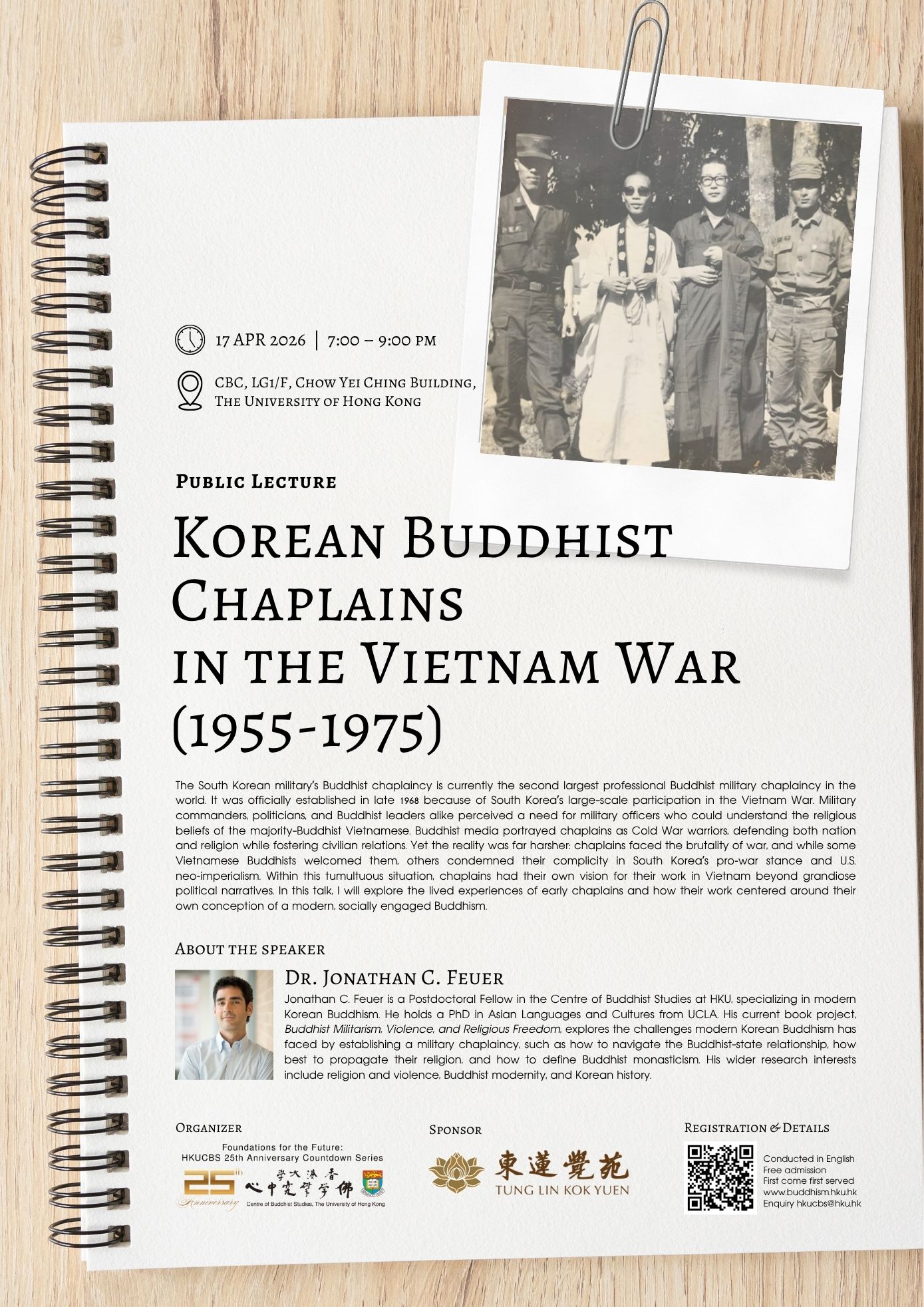
The South Korean military’s Buddhist chaplaincy is currently the second largest professional Buddhist military chaplaincy in the world. It was officially established in late 1968 because of South Korea’s large-scale participation in the Vietnam War. Military commanders, politicians, and Buddhist leaders alike perceived a need for military officers who could understand the religious beliefs of the majority-Buddhist Vietnamese. Buddhist media portrayed chaplains as Cold War warriors, defending both nation and religion while fostering civilian relations. Yet the reality was far harsher: chaplains faced the brutality of war, and while some Vietnamese Buddhists welcomed them, others condemned their complicity in South Korea’s pro‑war stance and U.S. neo‑imperialism. Within this tumultuous situation, chaplains had their own vision for their work in Vietnam beyond grandiose political narratives. In this talk, I will explore the lived experiences of early chaplains and how their work centered around their own conception of a modern, socially engaged Buddhism.
Conducted in English | Free Admission
All are welcome | First come first served
Enquiry | hkucbs@hku.hk
Organizer: HKU Centre of Buddhist Studies
Sponsor: Tung Lin Kok Yuen