Public Lecture
Buddhist Manuscript Studies in Southeast Asia:
The case of Luang Prabang, Laos
Invited Speaker
Professor Volker Grabowsky
Professor of Thai Studies and Head of the Southeast Asia Department at the Asia‑Africa‑Institute, University of Hamburg
Professor of Thai Studies and Head of the Southeast Asia Department at the Asia‑Africa‑Institute, University of Hamburg
Host: Professor David A. Palmer (HKIHSS & Sociology at HKU)
Language: English | Registration is not required
Date: January 16, 2026 (Friday)
Time: 3:00 pm – 4:30 pm (HK Time)
Venue: Rm 201, May Hall, The University of Hong Kong (Map),
or Via Zoom >> https://hku.zoom.us/j/98774269617
ABOUT THE SPEAKER
Volker Grabowsky is Professor of Thai Language and Culture (Thai Studies) and Head of the Southeast Asia Department at the Asia‑Africa‑Institute, University of Hamburg. A specialist in the history and culture of the Tai ethnic groups of mainland Southeast Asia and Southwest China, he previously held a professorship in Southeast Asian History at the University of Münster (1999–2009) and served as a DAAD visiting lecturer at the National University of Laos (1996–1999). He has published widely on Tai manuscript cultures, Buddhist literary traditions, and regional historiography. His works include major studies and translations of Tai Lü chronicles, such as the Chronicles of Chiang Khaeng (2008) and the Chronicles of Sipsòng Panna (2012). Since 2011, he has led several research projects on Tai manuscript cultures; his most recent edited volume is Manuscript Cultures and Epigraphy in the Tai World (2022).
ABSTRACT
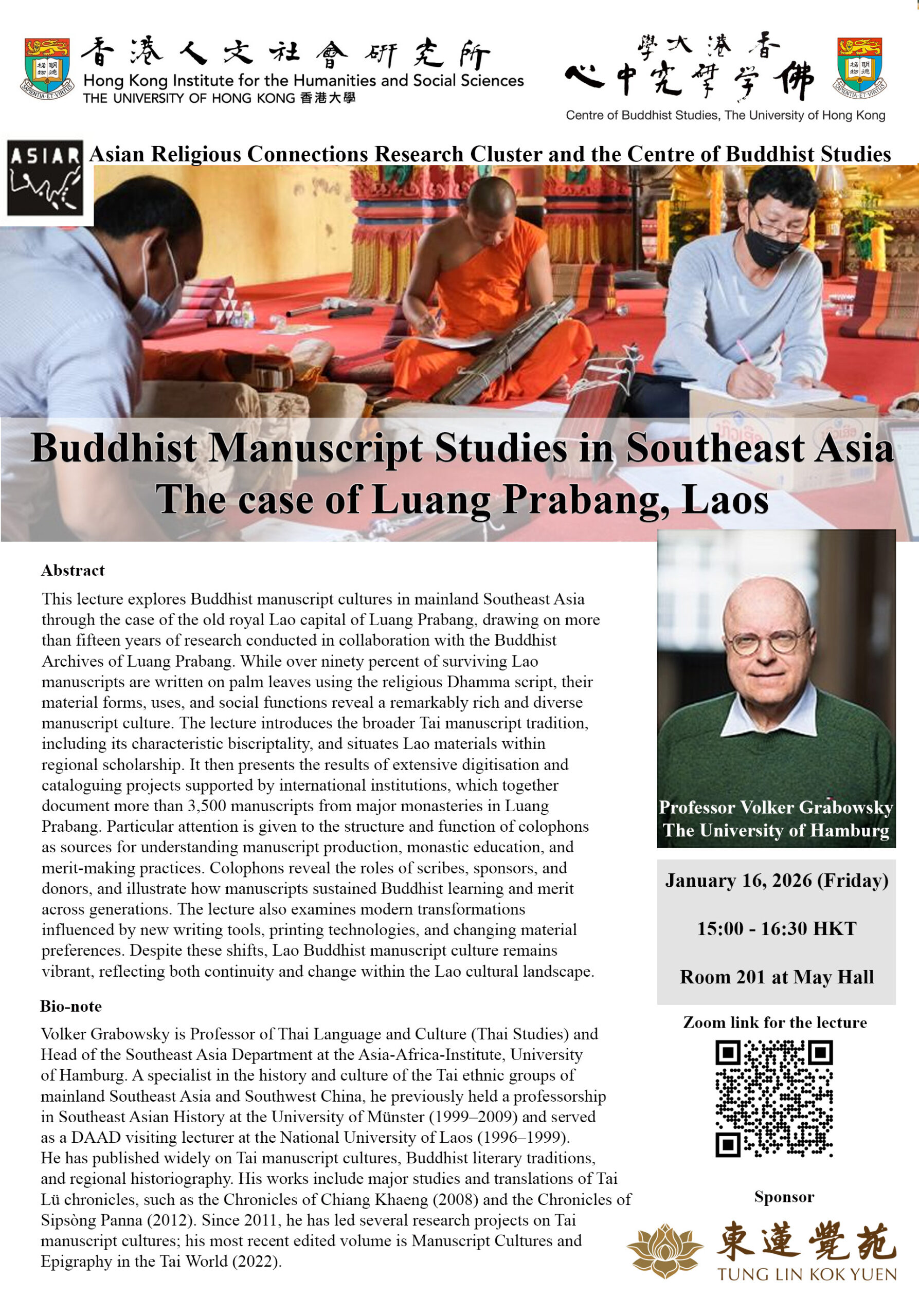
This lecture explores Buddhist manuscript cultures in mainland Southeast Asia through the case of the old royal Lao capital of Luang Prabang, drawing on more than fifteen years of research conducted in collaboration with the Buddhist Archives of Luang Prabang. While over ninety percent of surviving Lao manuscripts are written on palm leaves using the religious Dhamma script, their material forms, uses, and social functions reveal a remarkably rich and diverse manuscript culture. The lecture introduces the broader Tai manuscript tradition, including its characteristic biscriptality, and situates Lao materials within regional scholarship. It then presents the results of extensive digitisation and cataloguing projects supported by international institutions, which together document more than 3,500 manuscripts from major monasteries in Luang Prabang. Particular attention is given to the structure and function of colophons as sources for understanding manuscript production, monastic education, and merit‑making practices. Colophons reveal the roles of scribes, sponsors, and donors, and illustrate how manuscripts sustained Buddhist learning and merit across generations. The lecture also examines modern transformations influenced by new writing tools, printing technologies, and changing material preferences. Despite these shifts, Lao Buddhist manuscript culture remains vibrant, reflecting both continuity and change within the Lao cultural landscape.
Organizers
ASIAR Research Cluster, HKIHSS, HKU
Centre of Buddhist Studies, HKU
Sponsor
Tung Lin Kok Yuen