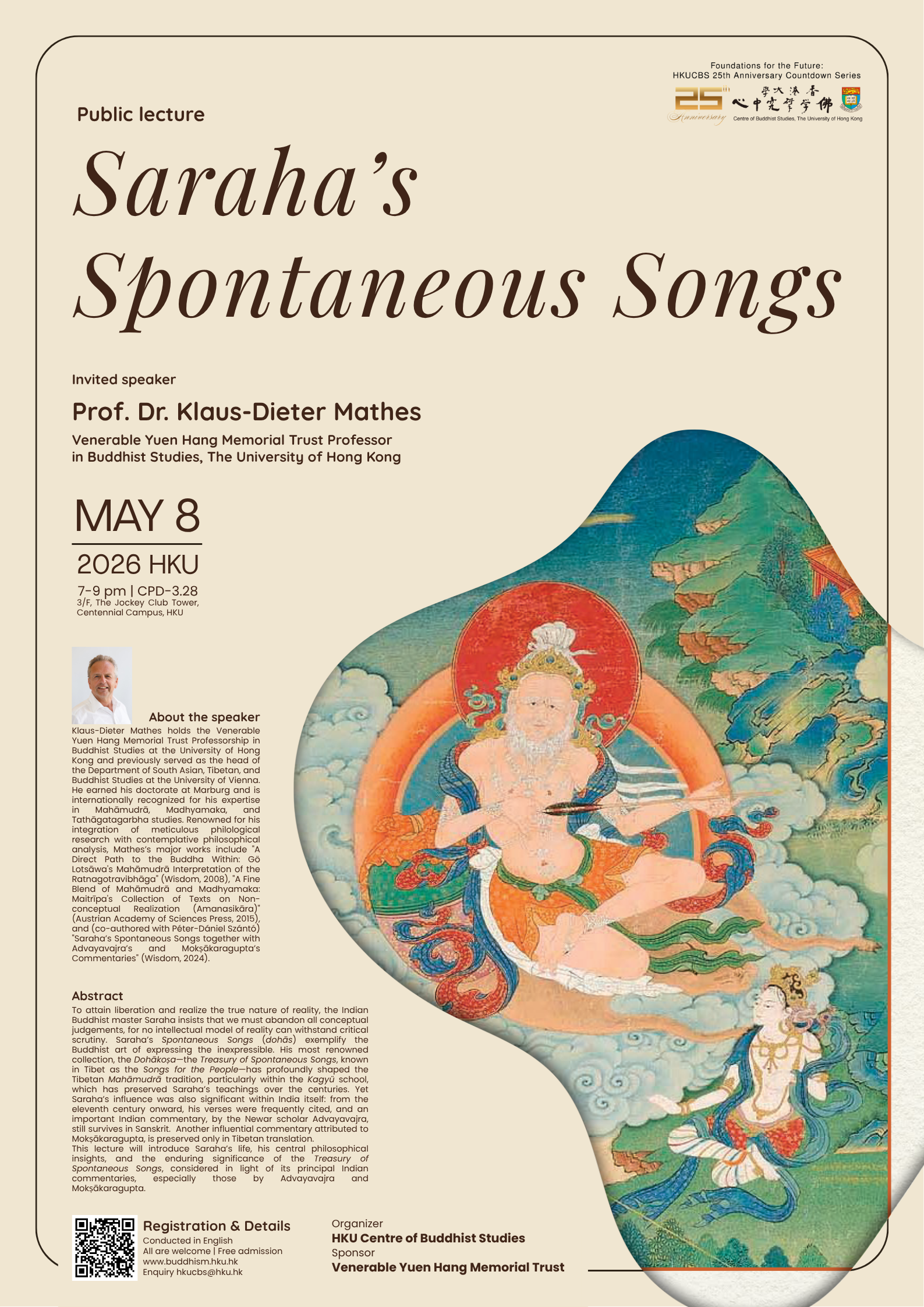
Saraha’s Spontaneous Songs
Invited speaker
Prof. Dr. Klaus-Dieter Mathes
Venerable Yuen Hang Memorial Trust Professor in Buddhist Studies, The University of Hong Kong
Time: 7:00-9:00 pm on 8 May 2026 (Friday) HK Time
Venue: CPD-3.28, 3/F, The Jockey Club Tower, Centennial Campus, HKU
About the speaker
Klaus-Dieter Mathes holds the Venerable Yuen Hang Memorial Trust Professorship in Buddhist Studies at the University of Hong Kong and previously served as the head of the Department of South Asian, Tibetan, and Buddhist Studies at the University of Vienna. He earned his doctorate at Marburg and is internationally recognized for his expertise in Mahāmudrā, Madhyamaka, and Tathāgatagarbha studies. Renowned for his integration of meticulous philological research with contemplative philosophical analysis, Mathes’s major works include “A Direct Path to the Buddha Within: Gö Lotsāwa’s Mahāmudrā Interpretation of the Ratnagotravibhāga” (Wisdom, 2008), “A Fine Blend of Mahāmudrā and Madhyamaka: Maitrīpa’s Collection of Texts on Non-conceptual Realization (Amanasikāra)” (Austrian Academy of Sciences Press, 2015), and (co-authored with Péter-Dániel Szántó) “Saraha’s Spontaneous Songs together with Advayavajra’s and Mokṣākaragupta’s Commentaries” (Wisdom, 2024).
Lecture abstract
To attain liberation and realize the true nature of reality, the Indian Buddhist master Saraha insists that we must abandon all conceptual judgements, for no intellectual model of reality can withstand critical scrutiny. Saraha’s Spontaneous Songs (dohās) exemplify the Buddhist art of expressing the inexpressible. His most renowned collection, the Dohākoṣa—the Treasury of Spontaneous Songs, known in Tibet as the Songs for the People—has profoundly shaped the Tibetan Mahāmudrā tradition, particularly within the Kagyü school, which has preserved Saraha’s teachings over the centuries. Yet Saraha’s influence was also significant within India itself: from the eleventh century onward, his verses were frequently cited, and an important Indian commentary, by the Newar scholar Advayavajra, still survives in Sanskrit. Another influential commentary attributed to Mokṣākaragupta, is preserved only in Tibetan translation.
This lecture will introduce Saraha’s life, his central philosophical insights, and the enduring significance of the Treasury of Spontaneous Songs, considered in light of its principal Indian commentaries, especially those by Advayavajra and Mokṣākaragupta.
Organizer: HKU Centre of Buddhist Studies
Sponsor: Venerable Yuen Hang Memorial Trust