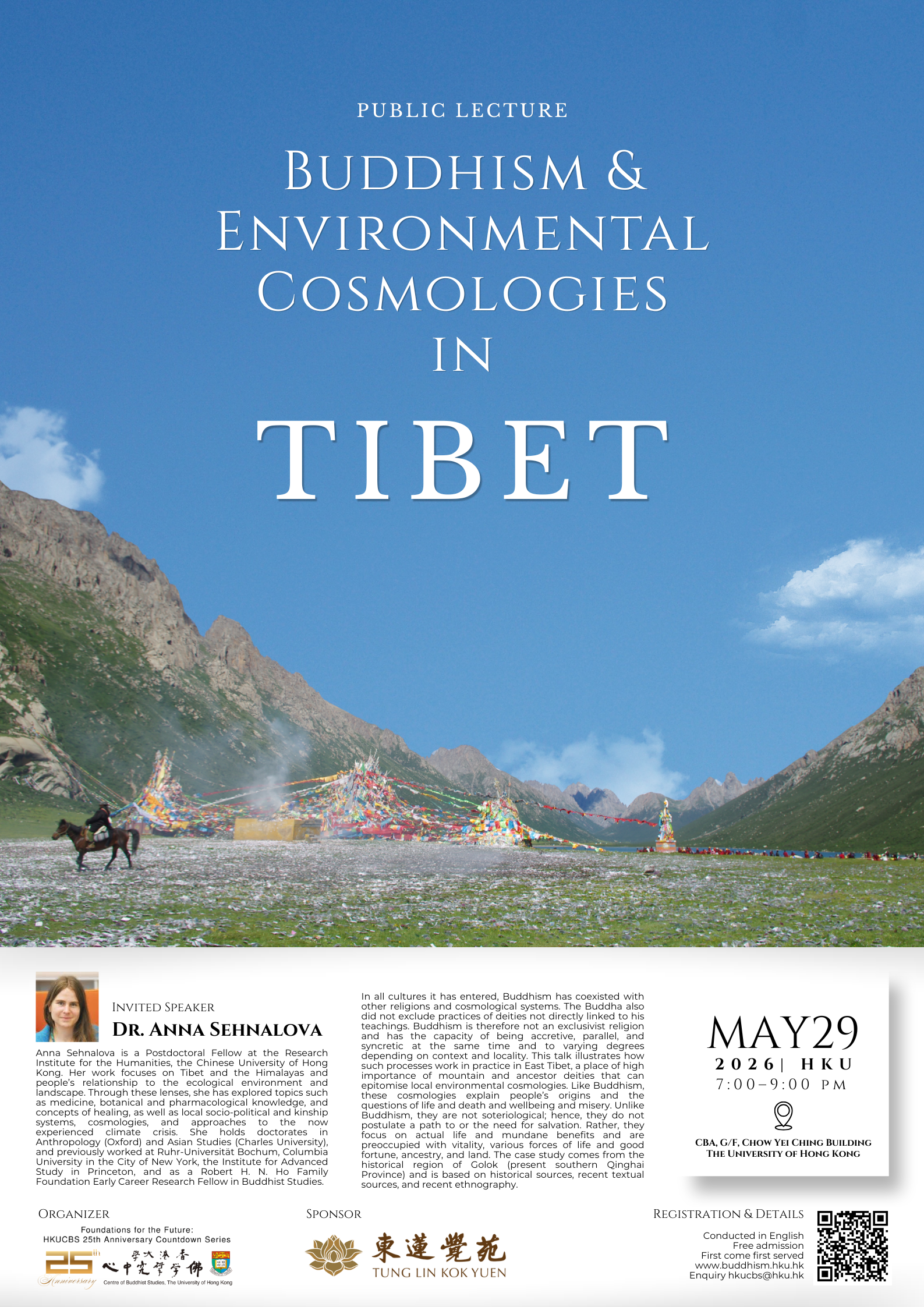
Buddhism and Environmental Cosmologies in Tibet
Invited speaker
Dr. Anna Sehnalova
Time: 7:00-9:00 pm on 29 May 2026 (Friday) HK Time
Venue: CBA, G/F, Chow Yei Ching Building, Main Campus, The University of Hong Kong
About the speaker
Anna Sehnalova is a Postdoctoral Fellow at the Research Institute for the Humanities, the Chinese University of Hong Kong. Her work focuses on Tibet and the Himalayas and people’s relationship to the ecological environment and landscape. Through these lenses, she has explored topics such as medicine, botanical and pharmacological knowledge, and concepts of healing, as well as local socio-political and kinship systems, cosmologies, and approaches to the now experienced climate crisis. She holds doctorates in Anthropology (Oxford) and Asian Studies (Charles University), and previously worked at Ruhr-Universität Bochum, Columbia University in the City of New York, the Institute for Advanced Study in Princeton, and as a Robert H. N. Ho Family Foundation Early Career Research Fellow in Buddhist Studies.
Lecture abstract
In all cultures it has entered, Buddhism has coexisted with other religions and cosmological systems. The Buddha also did not exclude practices of deities not directly linked to his teachings. Buddhism is therefore not an exclusivist religion and has the capacity of being accretive, parallel, and syncretic at the same time and to varying degrees depending on context and locality. This talk illustrates how such processes work in practice in East Tibet, a place of high importance of mountain and ancestor deities that can epitomise local environmental cosmologies. Like Buddhism, these cosmologies explain people’s origins and the questions of life and death and wellbeing and misery. Unlike Buddhism, they are not soteriological; hence, they do not postulate a path to or the need for salvation. Rather, they focus on actual life and mundane benefits and are preoccupied with vitality, various forces of life and good fortune, ancestry, and land. The case study comes from the historical region of Golok (present southern Qinghai Province) and is based on historical sources, recent textual sources, and recent ethnography.
Organizer: HKU Centre of Buddhist Studies
Sponsor: Tung Lin Kok Yuen